

 Current position > News detail
『Hydraulic Flow Meter with Pressure Gauge: Dual Readout System Diagnostics』Related information(clamp on meter|electromagnetic meter|venturi meterrotameter|orifice meter|ultrasonic flow meter|mass flow meter|coriolis mass flow meter|coriolis flow meter|magnetic flow meter|magmeter flow meter|magflow flow meter|mag meter flow meter|electromagnetic flow meter|vortex flow meter|turbine flow meter|thermal mass flow meter|thermal flow meter|rotameter flow meter)
Hydraulic Flow Meter with Pressure Gauge: Dual Readout System Diagnostics
Quick Answer: A hydraulic flow meter combined with a pressure gauge gives you real-time flow and pressure from a single instrument. This dual readout helps maintenance teams isolate pump wear, internal leakage, and valve failures in hydraulic systems without using two separate devices. Silver Automation Instruments supplies these diagnostic flow meters pre-plumbed with a pressure port and matched sensor so you can measure L/min and bar side by side during commissioning or troubleshooting.
Why a Dual Readout Matters in Hydraulic Diagnostics
Most hydraulic troubleshooting still relies on checking pressure alone. But pressure is only half the story. A blocked return filter can show normal pressure while flow drops. A worn piston pump can maintain pressure but deliver less oil to the actuator. When you carry a standalone pressure gauge and a separate flow meter you spend extra time breaking into lines, bleeding air, and recording values from two displays. You also risk misreading transient conditions because the two instruments are not synchronized.
A dual readout hydraulic flow meter with an integrated pressure gauge captures flow and pressure at the same sample point. You see exactly what is happening at that moment. This setup lets you diagnose conditions like high pressure with low flow, which typically points to a restriction downstream or a faulty directional valve. Low pressure with high flow often indicates excessive internal bypass in a cylinder or motor. You can spot these patterns in seconds because both values sit in one field of view.
What You Measure When You Have Flow and Pressure Together
Technicians use the combined reading to run structured diagnostics. One common test is a no-load flow check against a loaded flow check. You measure flow at a fixed engine RPM or motor speed with the hydraulic circuit in bypass and again under working pressure. A difference of more than 5 to 7 percent between the two readings tells you that internal leakage is present. With a dual readout instrument you also record the exact pressure at each condition. That data helps you calculate volumetric efficiency of the pump without writing numbers on a notepad and averaging them later.
Another test is cylinder bypass detection. You connect the flow meter in series with the cylinder return line and pressurize the piston side. The flow meter measures any leakage that slips past the piston seal. While doing this you watch the pressure gauge to confirm the test is running at the correct load. If flow appears on the return side while the cylinder is supposed to be static, you have a bypass problem. The simultaneous pressure reading confirms the test was not compromised by a relief valve cracking open.
You also catch relief valve set point drift. A properly set relief valve should fully close below its cracking pressure, showing zero flow through the valve. With the dual readout you can watch pressure climb and see the exact pressure at which flow begins to bypass. This is far more accurate than listening for a hiss or watching a needle bounce.
Typical Hardware Configuration from Silver Instruments
We build these dual readout systems around a positive displacement flow meter, usually an oval gear meter for hydraulic oils. Oval gear meters measure flow directly by counting displaced volume, so they work well with the high viscosity hydraulic fluids used in presses, injection molding machines, and marine steering systems. A common setup uses a DN15 or DN20 oval gear flow meter with a stainless steel body and FKM or PTFE seals, rated up to 400 bar depending on the manifold design.
A pressure transmitter or a glycerine-filled mechanical gauge is mounted on a shared manifold block right next to the flow meter inlet. The manifold has a dedicated pressure port machined to ISO 228 or NPT threads. Silver Automation Instruments pre-assembles and pressure-tests the complete block so you receive a single b
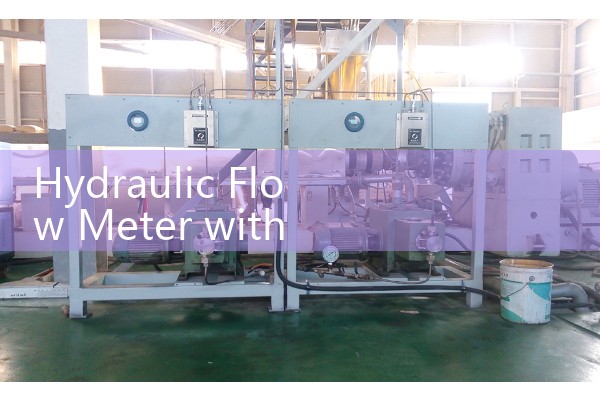
Typical ranges we supply: flow from 0.5 to 100 L/min, pressure from 0 to 400 bar, fluid temperature from -20 to 120 °C. For mobile hydraulics we add a protective rubber boot and shock-absorbing mounts. For ATEX Zone 2 areas in oil and gas we provide intrinsically safe transmitters and aluminum enclosures.
Field Case: Hydraulic Press Leak Found in Ten Minutes
Last year a manufacturer of rubber moulding presses in Thailand contacted Silver Instruments. They had a 200-ton press that was losing clamping force after two hours of running. Their maintenance team had already replaced the main pump and checked all pilot-operated check valves, but the press still drifted. They sent us their working pressure (210 bar), flow rate (45 L/min at 1500 RPM), pipe size (DN25), and oil grade (ISO VG 68). We supplied a dual readout kit with an oval gear meter and a 400-bar glycerine gauge on a common manifold.
The technician installed the meter in the main pressure line. At idle the system showed 48 L/min at 5 bar, which was normal. Under full clamping the flow dropped to 2 L/min at 210 bar, which also looked normal. But after 30 minutes the pressure stayed at 210 bar while the flow crept up to 9 L/min. The dual readout made the problem visible. The extra flow was going through a small internal leak in the pre-fill valve that only opened under heat soak. The maintenance lead told us later that without simultaneous flow and pressure on one gauge block, the team would have continued blaming the pump. Instead the valve was rebuilt the same afternoon.
FAQ
Q: Can I use the dual readout meter for both mineral oil and biodegradable hydraulic fluids? A: Yes. Silver Instruments offers seal options such as FKM for mineral oil and EPDM or PTFE for synthetic esters and polyglycols. When you inquire, tell us the fluid type and we will match the wetted materials.
Q: What is the smallest pipe size you can fit with a combined flow and pressure gauge? A: We build manifolds for DN10 and even 3/8 inch BSP lines. For low flow ranges down to 0.05 L/min we use a micro oval gear meter with an integrated pressure sensor. Send us your minimum and maximum flow and the line size so we propose the correct model.
Q: Does the dual readout system need external power? A: Not if you choose a mechanical pressure gauge and a local-display flow totalizer with battery. For 4-20 mA outputs and backlit digital displays, we can provide a 24 V DC loop-powered version or a rechargeable lithium battery pack that lasts 40 hours on a full charge.
Q: How do you compensate for viscosity changes in the field? A: Oval gear meters have a small slip amount that varies with viscosity. Our calibration sheet includes a viscosity correction curve for ranges between 10 and 500 cSt. On the digital unit with a temperature sensor, the display can apply automatic compensation if you log the oil type during setup.
Q: Can I buy the flow meter and pressure gauge as separate parts and mount them myself? A: You can, but we recommend the pre-assembled manifold block because it eliminates potential leak points and guarantees the pressure tap is in the correct turbulent-free zone. If you still prefer separate parts, we can supply a matched set with a drilling diagram for your own block.
Send us your pressure (bar), temperature (°C), pipe size (DN), and flow range. Email [email protected] or call +86-135-1213-1526. WhatsApp: 86-135-12131526. WeChat: +86 13512131526. Our application engineers will recommend a dual readout hydraulic flow meter assembly that fits your diagnostic routine and fluid type.