

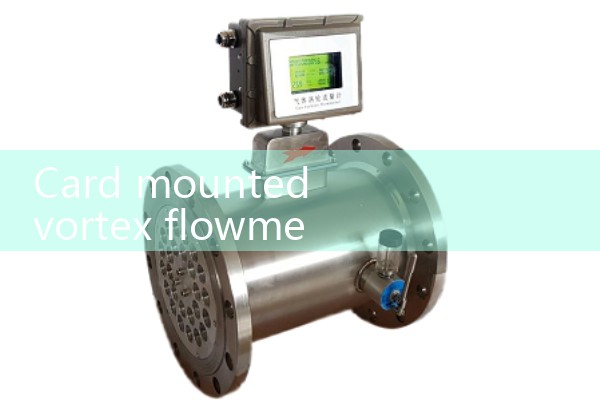
『Card mounted vortex flowmeter』Related information(clamp on meter|electromagnetic meter|venturi meterrotameter|orifice meter|ultrasonic flow meter|mass flow meter|coriolis mass flow meter|coriolis flow meter|magnetic flow meter|magmeter flow meter|magflow flow meter|mag meter flow meter|electromagnetic flow meter|vortex flow meter|turbine flow meter|thermal mass flow meter|thermal flow meter|rotameter flow meter)

1. Vortex flow sensor
In the late 1960s, a new type of instrument that applied the principle of fluid vibration to measure flow, namely fluid vibration flowmeter, emerged successively. There are currently two types of vortex flow meters that have been applied, one is the Karman vortex flow meter that uses natural vibration, and the other is the vortex flow meter that uses forced vibration. This high-sensitivity flowmeter has no movable parts inside the pipeline, a long service life, a wide linear range, and is almost unaffected by changes in temperature, density, pressure, viscosity, etc. It has low pressure loss and high accuracy. The output of the instrument is a pulse signal proportional to the volumetric flow rate, which is suitable for gases and liquids, so it is quite popular. According to fluid mechanics, the Karman vortex is known to occur behind a nonlinear object, such as a cylinder, triangular prism, etc., when the flow sail body advances at a certain speed v, if a nonlinear object is placed vertically on the path of advancement, a vortex will form behind the nonlinear object, forming the Karman vortex street. If the object is a cylinder with a diameter of d, research has shown that the frequency of vortices occurring behind the cylinder is the same as in the design and use of hydraulic power head core drilling machines, where v is the flow velocity; D is the diameter of the cylinder; St is a dimensionless number related to the Reynolds number Re, known as the Strouhal number. The experiment can determine the relationship between St number and Reynolds number, as shown in Figure 7-24. From the relationship between Strouhal number and Reynolds number (logarithmic) of the cylinder in Figure 7-24, it c
 Hot Blog
 Related AD