

『Everydrop Flow Meter Installation Manual: Connecting Smart Irrigation Controllers to Water Lines』Related information(clamp on meter|electromagnetic meter|venturi meterrotameter|orifice meter|ultrasonic flow meter|mass flow meter|coriolis mass flow meter|coriolis flow meter|magnetic flow meter|magmeter flow meter|magflow flow meter|mag meter flow meter|electromagnetic flow meter|vortex flow meter|turbine flow meter|thermal mass flow meter|thermal flow meter|rotameter flow meter)
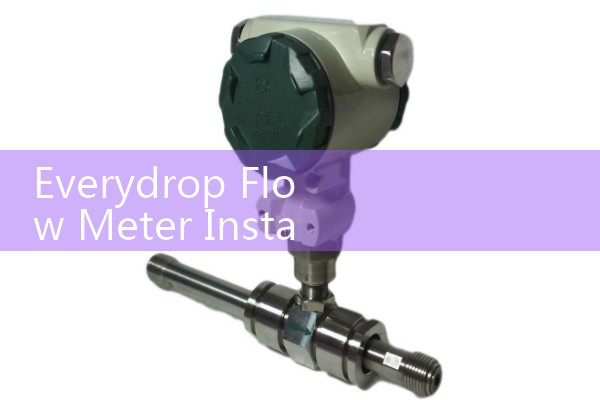
Everydrop Flow Meter Installation Manual: Connecting Smart Irrigation Controllers to Water Lines
Quick Answer: Install the Everydrop flow meter on the main water line after the backflow preventer and before the zone valves. Wire the pulse output to the sensor input on the smart controller. Enter the K-factor from the meter label into the controller software before the first watering cycle.
This guide covers real installation steps for contractors and maintenance teams. We have seen many installations on golf courses, commercial landscapes, and farms in Southeast Asia, the Middle East, and Australia. The goal is simple. Get stable pulse signals from the flow meter to the controller without false counts.
Installation Position on the Irrigation Water Line
Place the Everydrop flow meter on the main line after the backflow preventer. It must sit before the zone valves so it measures total flow for all zones. The meter body has an arrow. The arrow must point in the direction of water flow. Do not install the meter backwards. A backwards meter gives zero output or reverse pulse counts on some controllers.
Use a straight pipe section. Allow at least 10 pipe diameters of straight run upstream and 5 pipe diameters downstream. For a DN25 pipe, that means 250 mm of straight pipe before the meter and 125 mm after the meter. Most installers skip this part. That is a mistake. A 90 degree elbow or a partially open valve too close to the meter creates swirl. Swirl causes unstable readings and flow alarms.
If the water contains sand or organic solids, install a Y strainer before the meter. The paddle wheel inside the Everydrop meter can jam. We have seen a drip irrigation system in a Philippine greenhouse shut down because a small stone lodged in the paddle wheel. A strainer with a 1 mm mesh solves this.
Wiring the Everydrop Flow Meter to a Smart Controller
Everydrop flow meters usually have three wires. Red is 24 VAC positive. Black is common. Yellow or white is the pulse output. Connect red and black to the controller power terminals. Connect the pulse wire to the sensor input terminal. Hunter controllers may label the terminal as SEN. Rachio and Rain Bird use different names. Check the controller manual for the exact terminal.
Use an 18 AWG twisted pair cable for the pulse signal. Keep the pulse cable at least 30 cm away from 24 VAC zone valve wires. Parallel AC wires induce false pulses. A contractor in Vietnam had a flow total that was 3 times higher than expected. We moved the pulse cable away from the valve bundle and the total returned to normal.
Do not run the pulse cable in the same conduit as power wires. If you must cross a power line, cross it at 90 degrees. This reduces electromagnetic interference.
K-Factor and Controller Settings
The K-factor is printed on the meter label. It is a number that tells the controller how many pulses equal one liter or one gallon. Enter that exact number in the controller app. Do not copy a K-factor from another meter. Even two meters of the same DN size can have different K-factors.
In the controller software, select the flow sensor type as pulse. Then enter the K-factor. Set the flow alarm threshold to about 20 percent above the normal main line flow. For example, if a commercial landscape zone runs at 4.5 cubic meters per hour, set the alarm at 5.4 cubic meters per hour. This catches a broken pipe or a stuck valve without false alarms.
For controllers with no pulse input, use a flow meter with a 4-20 mA analog output. Silver Instruments supplies electromagnetic flow meters with 4-20 mA, pulse, and RS485 Modbus outputs on one device. The SEF series covers DN15 to DN300 and works well for irrigation main lin
Common Installation Mistakes on Customer Sites
One mistake is placing the meter too close to a ball valve. The valve creates a jet of water that hits the paddle wheel. The flow reading becomes noisy. Move the meter at least 10 pipe diameters downstream of the valve.
Another mistake is using a paddle wheel meter on a line with very low flow. Drip zones often run below 0.3 m/s. At that velocity, the paddle wheel may stop turning. For low flow irrigation, choose an electromagnetic flow meter. It has no moving parts and measures down to 0.1 m/s.
Air pockets also cause false pulses. Install an air release valve before the meter if the line has high points. A golf course in Queensland solved unstable readings by adding a small air release valve on a DN50 main line.
Industrial Flow Meter Alternatives for Irrigation and Water Lines
Everydrop flow meters work for small to medium landscape lines. For larger systems, for wastewater, or for treated effluent, we recommend industrial meters.
The Silver Instruments SEF electromagnetic flow meter handles DN15 to DN300. It measures 0.2 to 10 m/s with accuracy of 0.5 percent of reading. The liner options include PTFE and hard rubber. The electrodes are 316L stainless steel, Hastelloy, or titanium. Outputs include 4-20 mA, pulse, and RS485 Modbus. This meter works for raw water, river water, and treated wastewater in irrigation networks.
For existing above-ground PVC or steel pipes, use the Silver Instruments SUF clamp-on ultrasonic flow meter. It installs without cutting the pipe. It handles DN20 to DN600. The clamp-on sensors work well for temporary flow surveys and for irrigation lines that cannot be shut down for long.
For fertigation chemical dosing, use a small oval gear flow meter or a magnetic flow meter with PTFE lining. Fertilizer acids and chlorine solutions can damage plastic paddle wheels. A Silver Instruments SGF oval gear flow meter with 316L steel body handles low flows from 0.02 to 0.5 liters per minute. This is useful for dosing pumps in greenhouses and nurseries.
FAQ
Can I install the Everydrop flow meter on a vertical pipe?
Yes. Install it on a vertical pipe with upward flow if possible. Upward flow keeps the pipe full and reduces air pockets. The meter arrow must point up.
What K-factor should I use for a DN25 Everydrop flow meter?
Use the K-factor printed on the meter label. It is usually between 2.0 and 3.5 pulses per liter for a DN25 paddle wheel meter. Check your meter because values vary by version.
Why does my smart controller show flow when no zone is running?
This is often false pulses from nearby AC wires or a leaking valve. Separate the pulse cable from power wires. Check for a slow leak on the main line. If the meter has a reed switch, it can also trigger from vibration.
Can I connect the Everydrop flow meter to a Rachio controller?
Yes. Rachio supports pulse flow sensors on the sensor input. Power the meter from the 24 VAC terminals. Connect the pulse wire to the sensor terminal. Then enable the flow sensor in the Rachio app and enter the K-factor.
What is the minimum straight run for the Everydrop flow meter?
Use at least 10 pipe diameters upstream and 5 pipe diameters downstream. If you cannot provide this, use an electromagnetic flow meter. Magnetic meters are less sensitive to flow profile distortion.
For help with flow meter selection for smart irrigation, send us your pressure in bar, temperature in °C, pipe size in DN, and flow range in m³/h. Contact Silver Automation Instruments.
Tel: +86-25-68650347
Whatsapp: +86-25-52155837
WeChat: +86 15365082610
 Hot Blog
 Related AD