

『Vortex Flow Meter for Steam Application: High-Temperature Saturated Vapor Tracking』Related information(clamp on meter|electromagnetic meter|venturi meterrotameter|orifice meter|ultrasonic flow meter|mass flow meter|coriolis mass flow meter|coriolis flow meter|magnetic flow meter|magmeter flow meter|magflow flow meter|mag meter flow meter|electromagnetic flow meter|vortex flow meter|turbine flow meter|thermal mass flow meter|thermal flow meter|rotameter flow meter)
Vortex Flow Meter for Steam Application: High-Temperature Saturated Vapor Tracking
Quick Answer: A vortex flow meter with pressure and temperature compensation is a practical option for saturated steam lines from DN15 to DN300. Standard models handle 250 °C. High-temperature versions handle up to 350 °C. Correct sizing and straight pipe runs decide whether the meter reads within spec.
Steam flow measurement fails on many sites because the meter is sized for the wrong pressure or installed without enough upstream pipe. Silver Automation Instruments has supplied vortex steam meters to boiler houses, palm oil mills, and chemical plants in Vietnam, Thailand, the Philippines, and Mexico. The usual requirement is stable saturated vapor with known pressure and temperature.
Steam Flow Is Not a Dry Gas Problem
Saturated steam carries latent heat and small amounts of water droplets. Wet steam can erode the bluff body and reduce accuracy. Superheated steam is drier but needs higher temperature ratings. For saturated vapor tracking we recommend dry steam above 0.95 dryness fraction. Many boiler lines run at 0.95 to 0.98 dryness. That is acceptable for vortex meters.
The flow range depends on steam pressure. A DN80 meter at 10 bar can measure much more mass flow than at 3 bar. High pressure raises steam density. That is why a steam flow meter quote needs pressure data first. Do not size a steam meter from pipe diameter alone.
Vortex Shedding and Compensation
A vortex flow meter uses a bluff body inside the pipe. Steam passes the bluff body and forms alternating vortices. The sensor counts the vortex frequency. That frequency is proportional to flow velocity. The electronics convert frequency to volumetric flow. With pressure and temperature inputs the meter can output mass flow in kg/h.
For saturated steam we normally use an integrated pressure transmitter and a PT100 temperature sensor. The flow computer calculates steam density from steam tables. This is more accurate than using a fixed density value. Accuracy for a compensated vortex steam meter is usually plus or minus 1.5 percent of reading for liquids and plus or minus 2 percent for steam. The exact number depends on Reynolds number and installation.
High-Temperature Saturated Vapor Tracking
Most standard vortex meters handle up to 250 °C. High-temperature saturated steam systems can reach 300 °C to 350 °C at 40 to 80 bar. In those cases we use a version with a high-temperature sensor and no plastic parts. The electronics can be mounted remotely. The flow tube can be made from 316L stainless steel. The bluff body and sensor are welded into the meter body.
High temperature also affects the transducer. Piezoelectric sensors inside the meter must be isolated from heat. We use a sensor design with a sealing gland and ceramic insulation. That design allows the meter to survive continuous exposure to 350 °C without signal drift. For saturated steam above 350 °C we suggest checking the actual steam condition before quoting. Wet steam above 350 °C is aggressive.
Installation Rules That Prevent Meter Errors
Vortex meters need straight pipe. The general rule is 15D upstream and 5D downstream. D means nominal pipe diameter. So a DN100 meter needs 1500 mm of straight pipe before the meter and 500 mm after. If you have a control valve or elbow close upstream, add a flow straightener or increase straight run to 30D.
Do not install the meter at the lowest point of a steam line. Condensate collects there. The meter should be installed in a horizontal line with flow going up or in a vertical line with flow upward. This keeps water away from the bluff body. A good installation also includes a steam trap before the meter and a bypass line for maintenance.
We have seen customer sites where a vortex meter read 20 percent high because the meter was installed after an elbow with only 4D straight run. A paint factory in Indonesia had this problem. After adding a straight section the reading returned to normal. These details matter more than the meter brand.
Compensation Options and Output Signals
Most steam flo
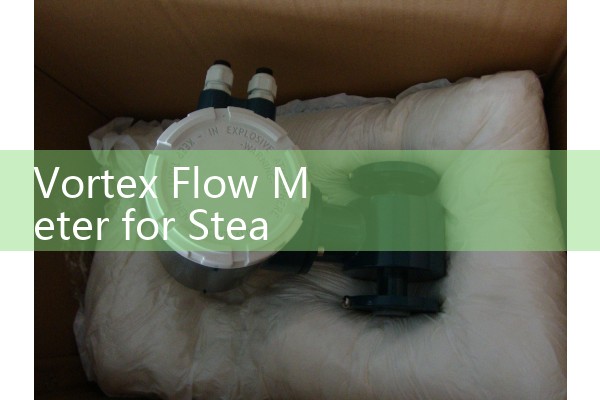
Temperature and pressure compensation can be internal or external. Internal compensation means the flow meter has inputs for a pressure transmitter and a PT100. The electronics calculate mass flow directly. External compensation means the DCS or PLC reads the pulse signal and does the steam table calculation. Most end users prefer internal compensation because that method is simpler.
Typical output options are 4-20 mA analog, pulse output for total flow, RS485 Modbus RTU, HART protocol on the 4-20 mA loop, and local LCD display with totalizer. We do not recommend battery-powered vortex meters for steam service. Steam lines are hot and battery life drops quickly. Use 24 V DC or 220 V AC power.
Material Selection and Approvals
The wetted parts for steam vortex meters are usually 316L stainless steel. For saturated steam from a standard gas boiler the body can be 304 stainless. But if the boiler water has high chlorides, specify 316L. Some customers need ATEX Zone 1 certification for steam lines near solvents or fuel gas. Silver Automation Instruments can supply vortex steam meters with Ex d or Ex ia approval. The certificate covers gas and dust groups. Please mention hazardous area classification in the inquiry. A typical tag for Zone 1 is Ex d IIC T6.
Recommended Models from Silver Automation Instruments
For saturated steam tracking we recommend the SVA-VS vortex flow meter series. This model has an integrated pressure sensor and a PT100 input. The SVA-VS can handle DN15 to DN300, steam pressure up to 25 bar standard, and temperature up to 250 °C standard or 350 °C optional. The accuracy is 1.5 percent of reading for steam with compensation.
For higher pressure steam up to 40 bar and temperatures up to 350 °C we recommend the SVA-VSH high-temperature vortex flow meter. The SVA-VSH has a remote electronics version for hot pipes. For large steam pipes above DN300 we suggest an insertion vortex flow meter. Do not select a steam flow meter based on price alone. A cheap meter without temperature and pressure compensation will not measure mass flow correctly. In a steam boiler application the error can cause wrong fuel consumption numbers.
How to Send a Steam Flow Meter Inquiry
Send us your pressure in bar, temperature in °C, pipe size in DN, and flow range in kg/h. Also tell us the steam type. Saturated steam and superheated steam need different sizing. If you have a control valve or pressure reducing station, tell us where the meter will be installed relative to the valve. The more data you send the faster we can quote.
You can contact Silver Automation Instruments at Tel: +86-135-1213-1526, WhatsApp: 86-135-12131526, WeChat: +86 13512131526. The website flow-meter.com.au shows the full vortex flow meter range. We ship to Southeast Asia, Oceania, Latin America, Africa, and the Middle East from our factory in China.
Frequently Asked Questions
Q: Can a vortex flow meter measure saturated steam mass flow directly?
A: Yes. The meter measures volumetric flow and the built-in pressure and temperature compensation converts that value to mass flow in kg/h.
Q: What temperature can a standard vortex steam flow meter handle?
A: Standard models handle up to 250 °C. High-temperature versions handle up to 350 °C.
Q: Is a vortex flow meter affected by wet steam?
A: Wet steam can reduce accuracy and erode the bluff body. Keep dryness fraction above 0.95 for long service life.
Q: What is the minimum straight pipe required for a steam vortex meter?
A: Use 15D upstream and 5D downstream as a minimum. More straight run is required after valves or elbows.
Q: What output signal is best for a boiler house steam meter?
A: 4-20 mA HART with RS485 Modbus is common. That combination allows the PLC to read flow rate and total flow at the same time.
 Hot Product
 Related AD